






Why Most Organizations Struggle with Performance and How to Fix It
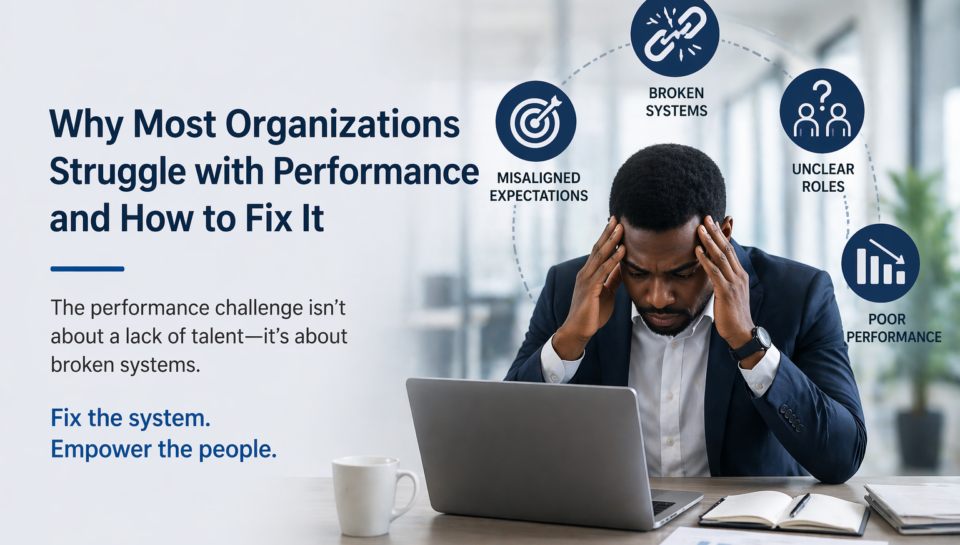
In today’s competitive business environment, many organizations continue to face a common challenge: underperformance of teams despite having skilled employees.
The immediate reaction is often to blame individuals. However, in our experience working with organizations across industries, the problem is rarely the people, it is the system within which they operate.
The Real Problem:
Broken Systems, Not Broken People
Most organizations lack clearly defined roles and expectations, Measurable performance indicators (KPIs), Structured feedback and accountability systems. Without these, even the most talented employees will struggle to perform.
When expectations are unclear, employees operate on assumptions. When performance is not measured, accountability becomes subjective. And when feedback is inconsistent, improvement becomes accidental rather than intentional.
The Leadership Gap
Leadership plays a critical role in shaping performance. Many managers focus on supervision rather than leadership. They prioritize task completion over team development. As a result:
Employees become dependent rather than empowered, innovation declines, and productivity plateaus. Effective leadership is not about control; it is about creating an environment where people can perform at their best consistently.
The Cost of Ignoring the Problem
Organizations that fail to address performance issues often experience:
High employee turnover, low morale and engagement, reduced productivity, and increased operational costs. Over time, these challenges directly impact profitability and long-term sustainability.
The Way Forward:
Building High-Performance Systems and Improving performance requires a deliberate and structured approach:
1. Define Clear Expectations
Every employee should understand what is expected of them, how their performance is measured and what success looks like.
2. Implement Measurable KPIs
Performance must be objective, trackable, and aligned with business goals.
3. Strengthen Leadership Capacity
Leaders must be equipped to coach and develop teams, communicate effectively, and drive accountability.
4. Create a Culture of Feedback
Regular feedback ensures continuous improvement, early problem identification, and stronger employee engagement.
Conclusion
High performance is not achieved by chance it is built through intentional systems, strong leadership, and clear accountability. Organizations that invest in these areas position themselves not only for improved productivity but for sustainable growth. At The Capital Group Ltd, we believe that transforming performance begins with transforming systems.